
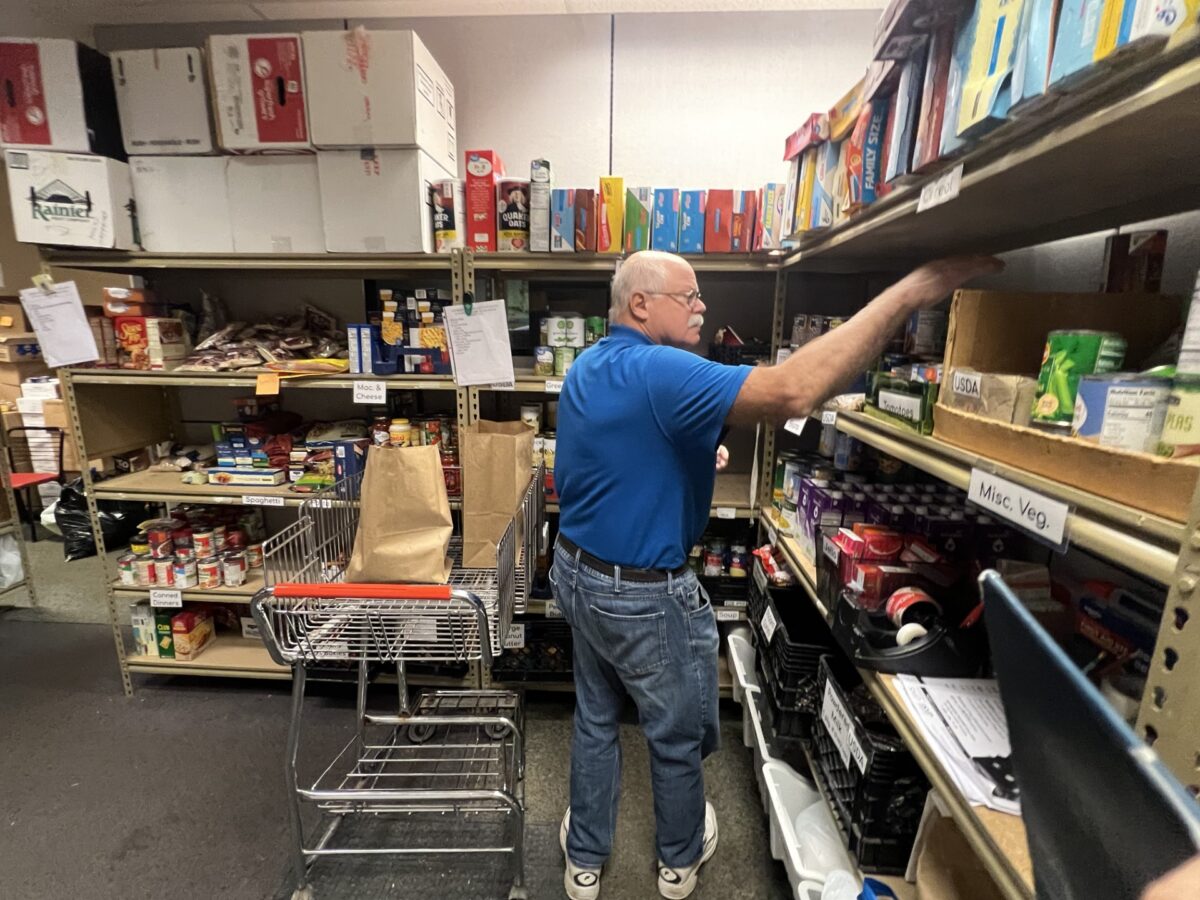
Volunteers at the Norfolk Food Pantry, located at 132 S. 4th St in Norfolk, NE, help pack food to give to food-insecure individuals in the area.
Reporter: Alejandro Ramirez / Norfolk Daily News
When asked how Food Bank for the Heartland was meeting a rising need for food amid rising costs, federal cuts, and the recent government shutdown, Stephanie Sullivan put it bluntly that “we’re not meeting the demand.”
“The gap between the need and the available resources to meet that need has never been wider,” said Sullivan, the food bank’s assistant director of marketing and communications. “There is simply not enough food for the influx of people who need it right now.”
Sullivan said food insecurity across the state continues to climb, putting stress on local communities and those who help provide food for people.
The mission of Food Bank for the Heartland, which is located in Omaha is to eliminate hunger by ensuring assistance and access to healthy foods through community partnerships.
The food bank serves 93 counties across Nebraska and western Iowa, the second-largest service area across Feeding America’s network of 200 food banks nationwide. It works with more than 500 network partners, including schools, local food pantries, and churches, to distribute food to the needy in each area of the state.
Per Feeding America, last year, 13.8% of Madison County residents were food insecure. This year, that number is up to 14.9%. From 2023 to 2025, there has been a nearly 50% increase in food insecurity levels in the county and the food bank’s coverage area in general.
Across the coverage area, 1 out of 7 people and 1 in 5 children are food insecure this year. Sullivan added that within the past couple of weeks, after the government shutdown, food pantries had seen more people needing assistance than ever before, with one pantry in Iowa reporting a record number of people seeking help.
Sullivan said the food bank’s local network partners also are reporting an increase of people who have never come to the pantry before.
“There’s never a good time for a government shutdown or to put barriers in place for people to access healthy foods,” Sullivan said. “But right in front of the holiday season is when we typically see food insecurity levels increase, so it truly could not come at a worse time.”
Good Neighbors is a charitable food pantry located in Norfolk that operates using volunteers provided by 14 churches. Allene Johnson, director of Good Neighbors, said the food pantry has seen around 30 new families a month for the past few months.
“We’ve had a lot of new families or people that have not been here for maybe 10 years, and now I’m seeing them come back,” Johnson said.
In total, the Norfolk Food Pantry averages around 200 families per month, with the week leading up to the shutdown seeing 85 families and continuing for more than two weeks.
Johnson said that at that time, she was thinking, “Oh my God, what am I going to do?” because the organization couldn’t keep up. More volunteers were brought in to prepack boxes of various sizes.
“It’s just a busy time because now we start taking names for Christmas boxes, and it all had to happen at one time,” Johnson said.
That number has thankfully eased off a bit, Johnson said, but there are still families that don’t make enough money to buy food. One client, she shared, makes $700 a month, and a lot of people coming in are retired and unable to work.
Johnson said a good number of the new families are in their 30s and 40s. She said some of these families don’t qualify for food stamps so they turn to the Norfolk Food Pantry, which follows USDA guidelines. She said the food pantry would never deny anyone food.
Northeast Nebraska Community Action Partnership (NENCAP) is a local organization that offers rental and utility assistance, as well as several food programs. Its main office is in Pender, and it serves 14 counties, with offices in Creighton, Norfolk, Fremont, and South Sioux City.
Megan Novak, grant coordinator, and Sarah Schweers, family services assistant director, shared that just for October, 151 unduplicated individuals were served in the food pantry program.
All of NENCAP’s locations with food pantries saw a big daily increase during the government shutdown, going from seeing around 10 people a month to roughly four or six people daily.
“Normally, we would see extreme low-income families,” Novak said, “and through that time, we were seeing more of the lower-class working families that depended on the SNAP benefits that no longer had that.”
Even before the shutdown, food banks were dealing with volatile times, with Food Bank for the Heartland seeing an 11% decrease in food distributed and a 6.5% increase in households served at the start of its fiscal year.
“That really shows you how we are distributing less food to more people,” Sullivan said.
SNAP and Government Cuts Take Toll
Food Bank for the Heartland offers a SNAP Outreach Team that helps individuals navigate and understand the application process quickly or points them to other resources if they don’t qualify.
Sullivan said that when programs like SNAP are disrupted, it creates a ripple effect that food pantries and the charitable food system can’t sustain.
“When any one of these programs are cut, even though the government has reopened, the damage has already been done, and we’re going to see that ripple effect for months to come,” Sullivan said.
Sullivan said the One Big Beautiful Bill could cut more than $200 billion from SNAP over the next decade, affecting 155,000 Nebraskans and 260,000 Iowans who receive benefits.
“This is creating uncertainty, fear, anxiety over people not being able to receive their benefits and receive as much as they used to,” Sullivan said.
She describes SNAP as a temporary but important lifeline that helps put food on the table for people who tend to cut food when budgets are tight.
“These changes in SNAP are putting additional barriers in place for people to be healthy and feed their families,” she said.
She said the loss of SNAP meals could not be made up through donated food or philanthropic dollars, adding that for one meal that a food bank provides, SNAP provides nine meals.
On top of SNAP disruptions, federal cuts to the Commodity Credit Corp. (CCC), which is a government-owned entity that provides additional food through The Emergency Food Assistance Program (TEFAP), also had affected the food bank.
The food bank also had to deal with a decrease in USDA commodities that canceled more than 434,000 meals that would’ve been distributed across its service area. As a result, this fiscal year, the food bank expects to see a 23% decrease in the amount of food received from the USDA.
“We’re doing everything we can to help our pantry network, but it’s really overwhelming for everybody involved,” Sullivan said.
For NENCAP, it has been business as usual in some of its other programs, although it’s much more cognizant of spending.
“They work very hard at making sure that our clients won’t suffer through these cuts, and, so we may have taken some other cuts of little things, you know, cut back on some spending so that way we can ensure that our clients are taken care of,” Novak said.
Proteins are among the most in-demand food items from the food bank, and protein donations are snapped up quickly by its local network partners.
Johnson said she counts on Food Bank for the Heartland for fresh meat for her freezers, but two freezers sit empty because of the short supply.
Partnerships and Community Support
Sullivan said the food bank has and will continue to make an impact on families needing help.
To try to meet the need, the food bank is focused on bringing more donated food to its warehouse, leveraging relationships and forging new relationships with retailers outside of the Omaha metro area.
“Not only can we increase the food donations, but provide more equitable food distribution across our service area, which is really important to us,” Sullivan said.
NENCAP also has looked for partnerships between local food pantries and organizations such as Orphan Grain Train to provide each other with food if they have extra.
“It’s been a really good help to know that we can work together on this,” Schweers said.
The food bank also expanded its retail rescue program, which allows network partners to pick up food directly from retail locations across its two-state area, allowing better access to healthier food while strengthening community bonds.
“We are continuing to strengthen and cultivate those new relationships, and this is vital as we navigate new challenges, especially with more than 500 network partners being impacted by those challenges,” Sullivan said.
The food bank also is moving to a new facility in January, which will offer more space to process food, and Sullivan called that an investment to continue supporting communities for years to come.
Since the shutdown, there has been an outpouring of support in terms of food and monetary donations.
“We are overwhelmed and beyond grateful for the way our community has responded,” Sullivan said, sharing that a donation drive in Omaha raised 41,000 pounds of food that was dispersed across its coverage area.
“We live in one of the most philanthropic areas in the entire country, so we are beyond grateful for the support that has been shown to us,” Sullivan said.
Novak credited Food Bank for the Heartland for helping NENCAP get USDA-labeled foods. She said the community has reached out to ask what is needed, particularly in gaining access to fresh produce, fruit and meat so families can have a whole meal.
“They are the support system that has helped us carry through this tough time in our government and make sure these families are fed through this time,” Novak said.
Sullivan said that while the shutdown is over, the problem has not been solved and that support is desperately needed beyond just the holiday season to make sure people are getting the help they need.
“Despite the harsh, challenging times we are going through right now, there is so much generosity in our community and so much compassion to help others in need, and we just need that compassion to continue,” she said.
Sullivan urges families needing help to not be afraid to ask for it.
“I know we live in a society that thrives on independence, but we are here to help those who are struggling right now get access to the food they need,” she said.
Sullivan said any action big or small makes a difference and that every bit helps.
“Anyone can make a difference, and we are seeing more innovative ways into how people respond to the hunger crisis,” Sullivan said.
Johnson said the pantry is in good hands thanks to the generosity of the community.
“I don’t care how many years you do this, I’m amazed every time,” Johnson said. “Because sometimes I don’t realize the community I live in, how blessed I am. I need that as a reminder once in a while.”